
 Home
Home About
About Technical team
 Business
 Innovation
 Sponge society
 Cooperation
 News
News Contact
hotline
010-68731953
© Zhonguancun Sponge Ctry Engineering Research Institute
Sponge Society
Alliance activity | the second online lecture on watershed and landscape was successfully completed
Publish date:2020/04/14 Click count:415 次
Under the epidemic situation in 2020, in order to resolutely implement the decision and deployment of the Party Central Committee and the State Council, help win the battle of epidemic prevention and control, fight the battle of ecological environment prevention and control, practice the responsibility and mission of improving ecological environment and building a livable home, Zhongguancun green wisdom sponge city ecological home industry alliance jointly launched a series of public welfare live lectures on water ecology with relevant organizations,
The first phase of water × landscape online public welfare live broadcast ushered in more than 5000 people watching, which caused great concern and repercussions in the industry, and also caused people to think about ecological design! This period of online activities of river basin × landscape has been successfully completed. In the future, we will invite experts from the industry to share their insights, strive to break the cross-border integration of cross disciplines, and jointly promote the comprehensive management of China's ecological environment and build a harmonious and livable home.
We welcome the active participation of government departments, project owners, scientific research institutes, planning, design and construction units to contribute to promoting ecological environment construction and guarding our homeland!
Mr. Wei Jun, vice president of the Ecological Environment Engineering Institute of East China survey, design and Research Institute of China Power Construction Corporation, and Mr. Zhang Li, deputy chief engineer of China design group and President of Shenzhen Branch, were invited to explain the key points of river and lake water system management with high ecological sensitivity from the perspective of basin environment and landscape evolution, including rainwater, sewage and water supply The problem of the water system also involves the connection of ecology, landscape, culture and other fields. The participants are deeply inspired to think and discuss the problems from different perspectives.
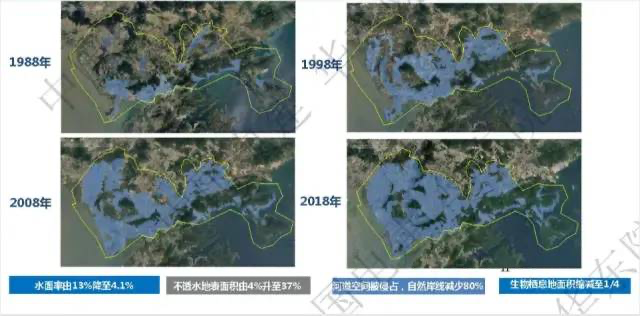
Wei Jun first introduced the water regime of Shenzhen in general. He pointed out that due to the strong human intervention in the water cycle system in the process of urbanization, the water cycle has been transformed into a "natural society" dual water cycle. In addition, Shenzhen is also faced with various problems, including the occupation of the space within the blue line of the river, the interweaving of flood, tide and waterlogging in extreme weather, and the difficulty in controlling point and non-point source pollution.
In order to explore the methods to solve the problems, we need to trace the source one by one. Wei Jun made a detailed analysis on the problems existing in the treatment of Maozhou River, and put forward the feasible treatment measures from various angles, such as sewage stripping and transfer, box culvert silting, etc. the plant, network, river and source should be corresponding to water and bank treatment, so as to completely eliminate the black odor. And make full use of the principle of sponge City, combined with its own characteristics to complete the organic integration treatment of non-point source pollution.
From specific measures to institutional concepts, Wei Jun further combed the innovative governance model of watershed planning. From the perspectives of attitude, planning direction, leadership mechanism, combat mode and work focus, Wei Jun introduced the governance basis of various planning systems of water governance, and shared the planning key points and top-level design principles in an easy to understand way.
Finally, Wei Jun showed the achievements of water regime management in Shenzhen, and introduced the changes and requirements of water management in the future. It emphasizes the important role of human to water environment, and thanks the builders.
Zhang Li first put forward the problems of river system and the collaborative needs of ecological planning of river basins. She believed that many ecological land functions overlapped and could be used intensively. Therefore, she proposed a multi-disciplinary collaborative ecological planning model, and proposed that watershed water system planning was the basis of ecological planning. Combining with the practical steps of ecological river planning and design, she compared the river sections before and after planning to explain the key points, and showed the importance of water system planning step by step.
In addition to the urban river system planning, the protection of natural rivers and wetlands is the most important. Zhang Li emphasized the concept of riverside zone. She believed that designers should pay attention to the complex function of land water interface and its ecological benefits. She suggested that on the basis of meeting the function of flood control, the meandering river channel should be kept as far as possible, and the ecological revetment should be constructed. Zhang Li pointed out that there is no need for additional drainage and purification in clear water biological system with stable biological chain, and stressed that although constructed wetland can be purified, the water discharged into the lake must be clean and cannot be expected to purify itself.
At present, the restoration of river and wetland ecological base flow mostly depends on groundwater, and some short-term solutions such as tail water purification and recharge are adopted. Zhang Li pointed out that in the long run, groundwater resources are very precious, and she hopes to supplement them from the perspective of planning. She thinks that the whole system process of rainwater should be regulated as much as possible in the planning. The connection with groundwater should be considered from the upstream, and the river base flow and water resources should be fully considered for planning. At the same time, the multi-functional mixing should be achieved as much as possible.
In terms of reducing non-point source pollution, Zhang Li analyzed the source of pollution, and introduced the water purification system of farmland non-point source pollution control. She proposed that river corridors can effectively remove pollutants and retain sediments, and gave an example of the application of constructed wetland technology in agricultural non-point source pollution control.
Finally, in terms of biodiversity conservation, she believes that indicator species and ecology should be identified under the "patch corridor matrix" model
The first phase of water × landscape online public welfare live broadcast ushered in more than 5000 people watching, which caused great concern and repercussions in the industry, and also caused people to think about ecological design! This period of online activities of river basin × landscape has been successfully completed. In the future, we will invite experts from the industry to share their insights, strive to break the cross-border integration of cross disciplines, and jointly promote the comprehensive management of China's ecological environment and build a harmonious and livable home.
We welcome the active participation of government departments, project owners, scientific research institutes, planning, design and construction units to contribute to promoting ecological environment construction and guarding our homeland!
Review of the second lecture
Mr. Wei Jun, vice president of the Ecological Environment Engineering Institute of East China survey, design and Research Institute of China Power Construction Corporation, and Mr. Zhang Li, deputy chief engineer of China design group and President of Shenzhen Branch, were invited to explain the key points of river and lake water system management with high ecological sensitivity from the perspective of basin environment and landscape evolution, including rainwater, sewage and water supply The problem of the water system also involves the connection of ecology, landscape, culture and other fields. The participants are deeply inspired to think and discuss the problems from different perspectives.

Wei Jun
Interpretation of the largest domestic EPC project of water environment treatment -- Maozhou river treatment practice in ShenzhenWei Jun first introduced the water regime of Shenzhen in general. He pointed out that due to the strong human intervention in the water cycle system in the process of urbanization, the water cycle has been transformed into a "natural society" dual water cycle. In addition, Shenzhen is also faced with various problems, including the occupation of the space within the blue line of the river, the interweaving of flood, tide and waterlogging in extreme weather, and the difficulty in controlling point and non-point source pollution.
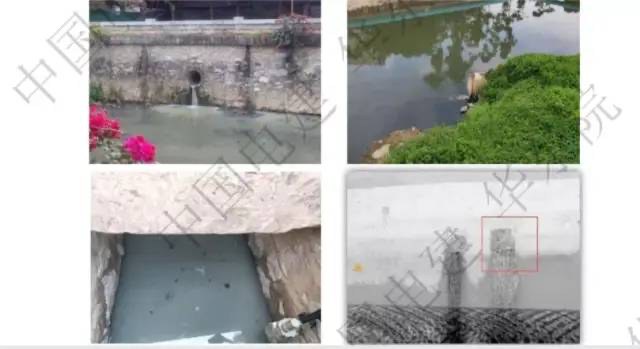
In order to explore the methods to solve the problems, we need to trace the source one by one. Wei Jun made a detailed analysis on the problems existing in the treatment of Maozhou River, and put forward the feasible treatment measures from various angles, such as sewage stripping and transfer, box culvert silting, etc. the plant, network, river and source should be corresponding to water and bank treatment, so as to completely eliminate the black odor. And make full use of the principle of sponge City, combined with its own characteristics to complete the organic integration treatment of non-point source pollution.
Schematic diagram of sewage outlet treatment
From specific measures to institutional concepts, Wei Jun further combed the innovative governance model of watershed planning. From the perspectives of attitude, planning direction, leadership mechanism, combat mode and work focus, Wei Jun introduced the governance basis of various planning systems of water governance, and shared the planning key points and top-level design principles in an easy to understand way.
General idea chart of watershed management
Finally, Wei Jun showed the achievements of water regime management in Shenzhen, and introduced the changes and requirements of water management in the future. It emphasizes the important role of human to water environment, and thanks the builders.

Zhang Li
River system planning and ecological planningZhang Li first put forward the problems of river system and the collaborative needs of ecological planning of river basins. She believed that many ecological land functions overlapped and could be used intensively. Therefore, she proposed a multi-disciplinary collaborative ecological planning model, and proposed that watershed water system planning was the basis of ecological planning. Combining with the practical steps of ecological river planning and design, she compared the river sections before and after planning to explain the key points, and showed the importance of water system planning step by step.
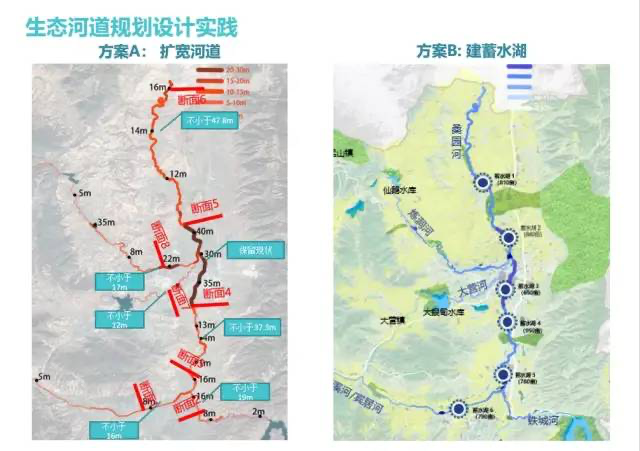
Schematic diagram of river flood control planning: a widens river channel, B builds flood storage lake.
In addition to the urban river system planning, the protection of natural rivers and wetlands is the most important. Zhang Li emphasized the concept of riverside zone. She believed that designers should pay attention to the complex function of land water interface and its ecological benefits. She suggested that on the basis of meeting the function of flood control, the meandering river channel should be kept as far as possible, and the ecological revetment should be constructed. Zhang Li pointed out that there is no need for additional drainage and purification in clear water biological system with stable biological chain, and stressed that although constructed wetland can be purified, the water discharged into the lake must be clean and cannot be expected to purify itself.
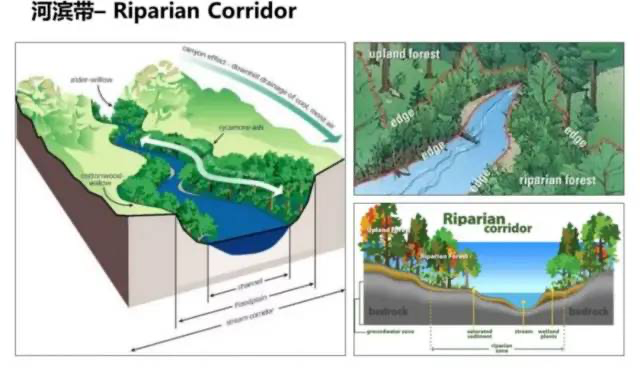
Conceptual sketch map of riverside zone
At present, the restoration of river and wetland ecological base flow mostly depends on groundwater, and some short-term solutions such as tail water purification and recharge are adopted. Zhang Li pointed out that in the long run, groundwater resources are very precious, and she hopes to supplement them from the perspective of planning. She thinks that the whole system process of rainwater should be regulated as much as possible in the planning. The connection with groundwater should be considered from the upstream, and the river base flow and water resources should be fully considered for planning. At the same time, the multi-functional mixing should be achieved as much as possible.
In terms of reducing non-point source pollution, Zhang Li analyzed the source of pollution, and introduced the water purification system of farmland non-point source pollution control. She proposed that river corridors can effectively remove pollutants and retain sediments, and gave an example of the application of constructed wetland technology in agricultural non-point source pollution control.
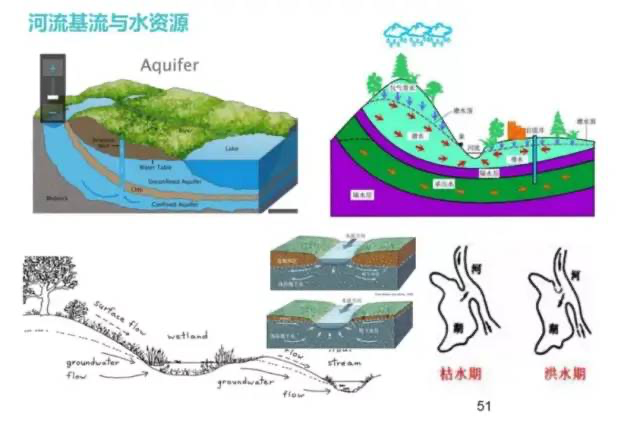
Schematic diagram of river base flow and water resources
Finally, in terms of biodiversity conservation, she believes that indicator species and ecology should be identified under the "patch corridor matrix" model
-

 010-68731953
 -



-


-

